Non-fiction
Edited by Roger W. Lotchin
Published by The Lakeside Press (hardback)
306 pages long, over a quarter of it is pictures though
First published in 2011
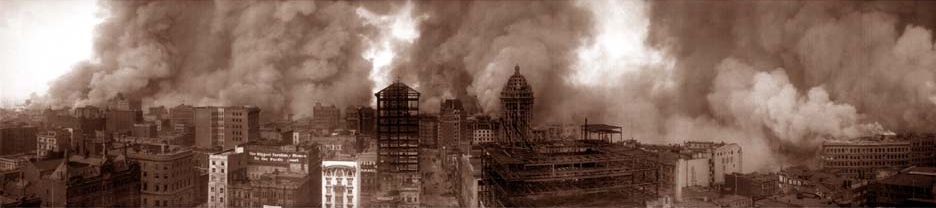 |
| San Francisco burning in 1906. |
By Pillsbury Picture Co. - This image is available from the United States Library of Congress's Prints and Photographs divisionunder the digital ID pan.6a01913, Public Domain, Link
Description
In 1906, a 7.9 earthquake set San Francisco on fire. This book is a collection of first-person accounts, from people in every walk of life as they watched the great city burn.
(If you don't like history this might be a dull review)
First, some history of Lakeside Press
Started in 1903, the creators wanted to "convey the idea that machine made books are not a crime against art".
This edition is a little green hardback, and it does feel like an expensive book from years gone by. The inside is quite modern however (for better or worse) with introductions, pictures, maps (though not enough) photos, indexes and unhelpful footnotes at the end of every chapter. (I looked up "Home of Truth" which was obviously a religion of some sort and the description was "A spiritual sect in the East Bay". Well I figured that.)
The other books from Lakeside I have read, like this one, stay as true as possible to the source material (plenty of racism for everybody) while putting it in modern English. I think it’s a pretty good deal as the books are not expensive at all for the quality.
My thoughts
I enjoyed this book more than I thought I would. I was afraid it would get dry and repetitive, but it was fairly short. Lakeside probably picked the best of the best, or at least the most distinct. There were very little crossover reports of events.
People include Jack London (author of Call of The Wild) reporters, nurses, opera singers, businessmen (no fire fighters though) soldiers and the like.
The History I learned, spoilers for a real event
An earthquake occurred at five in the morning of Wednesday, April 18, 1906.
The quake not only started fires, killed people, broke water lines and took out communication but killed the fire chief as well. The firefighters, with help from the army and citizens, were able to (mostly) put out the fire by the fourth day.
But even in those three days, estimated deaths vary between 700-3,000, with the latter probably being closer to the truth. Between 227,000 and 300,000 (out of 440,000) people became homeless. Over four square miles were burned.
It remains the greatest natural disaster to ever occur in California, and in the top three in American history.
But even with of all of this, there is good.
The Southern Pacific Railroad took victims out of the city for free to the surrounding Bay Area. All in all, they did end up transporting more people than there were victims, but no official complaints were made.
Money poured in from all over the world, Japan being one of the biggest donors at 250,000 dollars. 100,000 of which is rumored to be from the Emperor's own pocket. The amount of money coming in surprised the people, as there were stories going around that the entire west coast had been hit by the same earthquake and San Francisco was the only survivor.
Whites, blacks and Chinese (Chinatown was almost completely lost by the fire) all camped side by side for days. No real fights ever broke out.
Banks allowed people to make transfers form San Francisco banks (that no longer existed) to theirs with no fees.
There were also rumors of worse things happening, of soldiers shooting civilians, out of control ransacking and nurses euthanizing patients. The latter two are certainty not true, the soldiers probably didn't shoot any-one even though no looting (even of grocery stores fixing to burn) was allowed under martial law.
Over all these reports describe a quiet and resigned people.
Some of the chapters
I really can't explain this book. Each person they chose here has a very distinct voice and personality that comes across. Some I did not like, others I would read a book about. I think Lakeside went out of its way to find the more hopeful eye-witness accounts, which I am fine with. You can look at the numbers and know how bad things were, (there were one or two graphic moments) it is harder to see the good.
I found Henry Anderson Lafler comparing the thought of '20,000 copies of his magazines going up in flame the same as having a gross typo on the first page' much funnier than I should of. He also reported several jokes. Once, when passing a family evacuating from their house, which had a for sale sign up front, he heard someone offer two bits for it. The father said make it a dollar and you have a deal.
I don't like General Fredrick Funston, he seemed to be almost taking joy in the people needing to be kept under control by the army.
I also learned about Donaldina Cameron. She was Presbyterian missionary running a rescue for the Asian Women brought to San Francisco for the brothels. She was known as the "Angry Angel of Chinatown".
For some reason Mary Edith Griswold reminded me of the main character from Breakfast at Tiffany's, except fun.
This book is a mix of fun and of course great tragedy. A look at a slice of humanity when disaster happens, and how we have overcome it.
Interesteing. Maybe I'll read it.
ReplyDelete