Fiction
Written by Gilbert Keith Chesterton 1874-1936
First published in 1911
My edition published by A to Z Classics (e-book)
174 pages long (paperback)
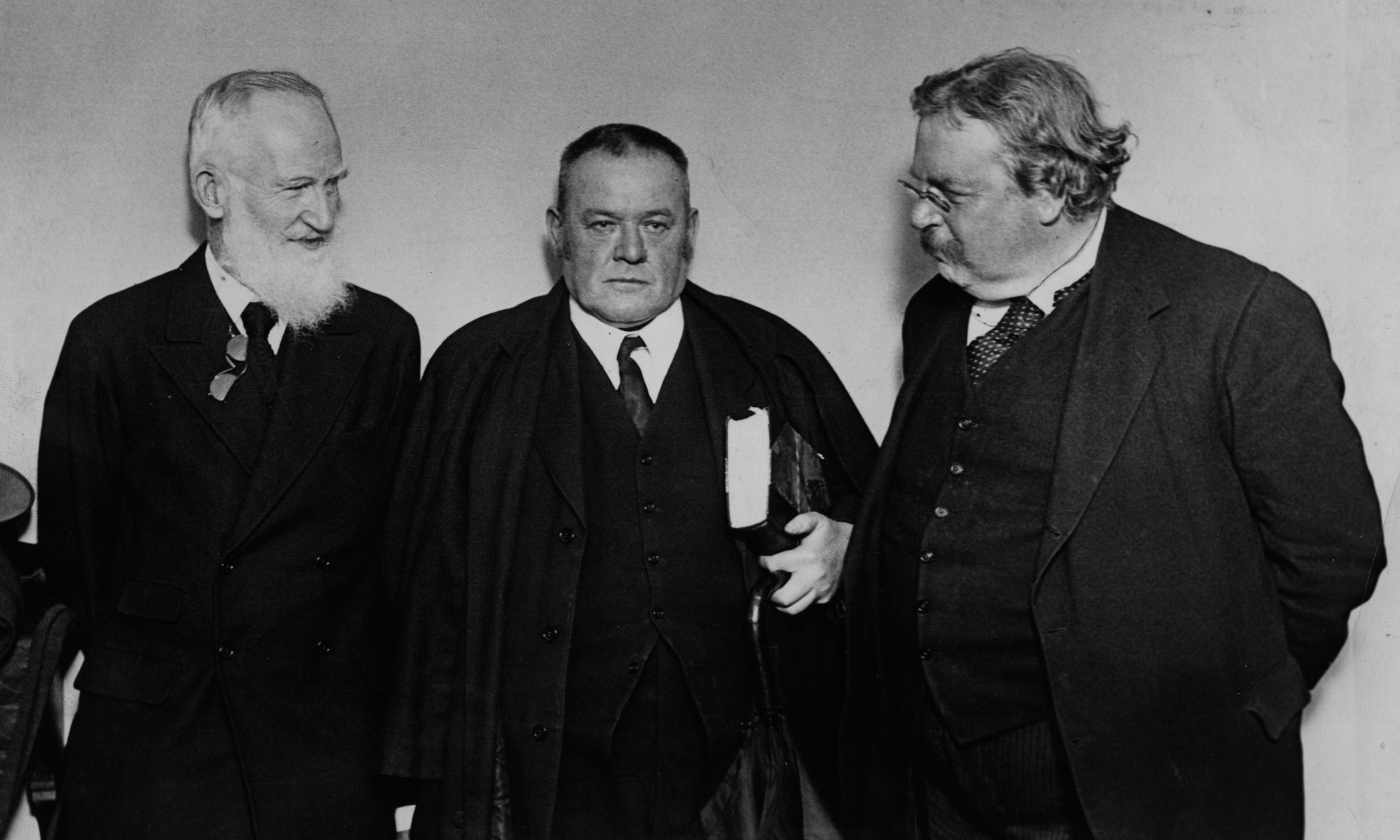 |
| George Bernard Shaw, Hilaire Belloc, and G. K. Chesterton. Chesterton and Shaw were close friends despite not agreeing on anything. |
By Unknown - Chesterton Brasil: http://chestertonbrasil.blogspot.com.br/2012/07/os-tres-tipos-de-homens.html, Public Domain, Link
Description
Father Brown is an easy to overlook, round faced priest with a worryingly large collection of criminal how-to knowledge. This book is a collection of the priest’s first 12 short stories where he solves everything from thefts to murders.
My Thoughts
It is surprisingly hard to write a review for a collection of short stories. Overall it is going to be the same as my other Father Brown review, the character hasn't changed. And neither has the writing style, which I still find confusing sometimes.
Though Chesterton was a Christian, he often struggled with fitting in with any denomination, and perhaps that is why Father Brown never really comes across as a preacher. Both Writer and character are next to impossible to pin a description on.
The mysteries are...odd, I guess? I was able to solve a few, but others were so bizarre I don't know how anyone (including Father Brown) could have possibly guessed.
The stories also keep doing this 'bait and switch' thing. We set up an atheist vs Christian thing, and then go take down the Pegan. Or vice versa, I don't think the opponent in the beginning is ever the same religion as one at the end.
An interesting read to be sure. Somewhere between quirky and deep. Which I realize is not helpful, but neither is Father Brown most of the time, so I don't care.
The Short Stories
In taking advantage of Father Brown being in the Public Domain, I have quoted a few passages from the book. Just keep in mind most of them are severely abridged. This is the early 20th century, why use 100 words if a 1,000 will do?
The Blue Cross-In this one we are not only introduced to Father Brown, but Flambeau as well. He is a master thief that is making his escape, but Brown is tagging along and leaving a trail for the law to follow.
The Secret Garden-Police Chief Valentin is throwing a party and quite a selection of people are invited, so of course politics come up.
"A Socialist means a man who wants all the chimneys swept and all the chimney-sweeps paid for it"
"But who won't allow you," put in the priest in a low voice, "to own you own soot."
Crook looked at him with an eye of interest and even respect. "Does one want to own soot?" he asked.
"One might, answered Brown with speculation in his eye. "I've heard that gardeners use it. And I once made six children happy at Christmas when the conjuror didn't come, entirely with soot-applied externally."
Blackface aside, this is one of the few times Chesterton makes Father Brown's view on politics or religion plain. Not that Father Brown avoids the issue when asked, he just gives an answer that doesn't answer the question but catches you so off guard you have to stop and think about it for a while.
But then a decapitated corpse if found in the garden so we can quit talking about politics. Which is fine with me.
12 Fishermen-This one was kind of dull. Not being overly familiar with the culture of the time and place didn't help. (Mild spoilers) It has nothing to do with fishing, it is about someone steeling silverware at a party.
Falling Stars-Another house party gone bad. (Spoilers)They beat a cop on stage, I don't think we kill him but I'm not sure. Father Brown convinces Flambeau to come over to the side of the law in this one.
The Invisible Man-We have robots now. They don't even have a big impact on the story, just this one guy has an entirely mechanical staff. Which is odd.
Did you know that the post (mail) was delivered 12 times a day in Victorian London? It was considered rude if you didn’t respond within immediately to a letter. (And yes, I know that 1910 wasn't during the Victorian era, but it's close enough.)
The Honor of Israel Gow-This story was kind of cool, Chesterton was aiming for an almost Gothic Horror feel in this one. An old miser dies and when the locals go through his house, they find candles but no candle sticks, loose gems and the word "God" removed from the family Bible.
The Wrong Shape-Once again this one is kind of dull. The 'wrong shape' refers to the house and a knife. Neither of which comes into play because of their shape.
The Sins of Prince Sardine- In this one we join Flambeau (who is a detective now) on a boat trip up a reed-filled river. He brings
"A tin of salmon if he should want to eat. Loaded revolvers if he should want to fight. A, bottle of brandy, presumably, in case he should faint. And a priest, presumably, in case he should die."
"I never said it was always wrong to enter fairyland, I only said it was dangerous"-Father Brown
This story does almost feel as if our main characters had an adventure in fairy land.
The Hammer of God-Not a very interesting one, I thought we were going in a tragic direction for a bit, but we didn't.
The Eye of Apollo-We dip our toe into cults for this one. Once again, I thought we were going to have a Christian vs other discussion. But when Brown was asked what he thought of the New Pagans he responded, "A resurgence of the old variety would be less dangerous for the people, as at least the old ones understood that nature was sometimes cruel."
The Sign of the Broken Sword-Flambeau and Father Brown are walking around looking at the monuments of a Sir Arthur St. Clare, Brown explaining something he has realized about the long-dead war hero. The mystery is what really happened during his last stand.
Another interesting quote...
"Sir Arthur St. Clare, as I have already said, was a man who read his Bible. That was what was the matter with him. When will people understand that it is useless for a man to read his Bible unless he also read everybody else's Bible? A printer reads a Bible for misprints. A Mormon reads his Bible, and finds polygamy; a Christian Scientist reads his, and finds we have no arm and legs. St. Clare was an old Anglo-Indian Protestant soldier. Of course, he reads the Old Testament rather than the New. Of course, he found in the Old Testament anything that he wanted-lust, tyranny treason. Oh I dare say he was honest, as you call it. But what is the good of a man being honest in his worship of dishonesty?"
Like with the pagan quote earlier, I don't know how right Brown is, but he might be correct. He keeps making me stop and think and I like that.
The Three Tools of Death-sort of like a fair-to-middling Murder She Wrote episode. Fairly obvious but that has mostly to do with how often this story line has been used since. It is also sad.
"If ever I (Father Brown) murdered somebody," he added quite simply, "I dare say it might be an Optimist."
"People like frequent laughter," answered Father Brown, "but I don't think they like a permanent smile. Cheerfulness without humor is a very trying thing."
This statement was made after a well-known "cheerful" man was found murdered, and someone mentions that his household will no longer be cheerful, and Father Brown points out that a truly cheerful person would leave sunshine behind, even after their death. While are victim here does not.
Okay, I have to read these
ReplyDeleteMaybe just for Flambeau
I don't know if it was me or the writing, but I hadn't noticed Flambeau's redemption at all. I read about it in other people's reviews. It was probably me though. All the Father Brown books are free on Kindle, he's over a hundred years old so he's public domain.
Delete