 |
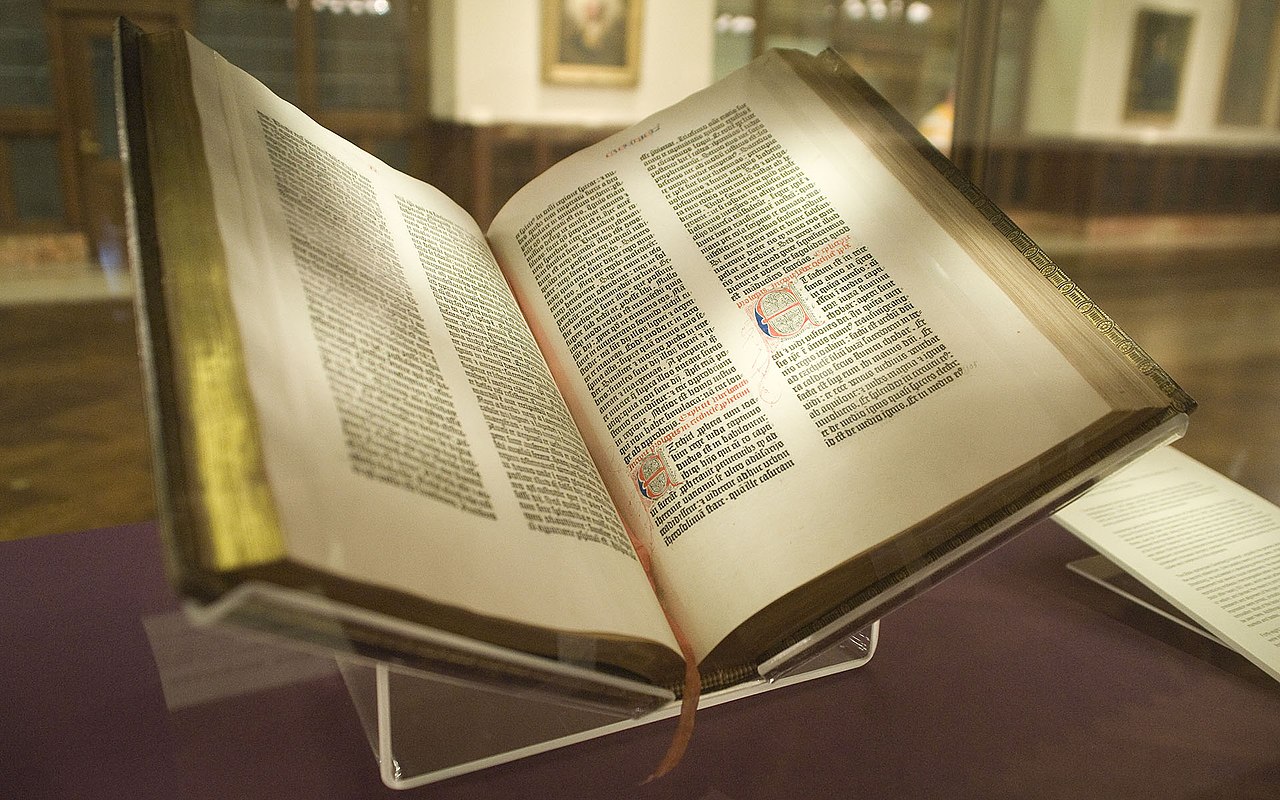
| The Bible is the sacred book in Christianity. |
By NYC Wanderer (Kevin Eng) - originally posted to Flickr as Gutenberg Bible, CC BY-SA 2.0, Link
KJV, NIV, red letters, Strong’s...which one has Jesus in it?
I decided to write this after realizing the frustration I had in finding which version of the Art of War was best, would be nothing compared to those trying to read the Bible for the first time.
Even from an atheist point of view the Bible would have to be one of the most influential books of all time. But a book that has been around this long will have many different versions, and like with other classics, trying to find which one is the best will often lead you to threads that are more concerned with promoting (or demonizing) there pet translations than actually stating the difference.
If I had picked up the Bible blind, I probably would not have finished it. The "little prophets" near the end of the Old Testament would have stopped me if Kings and Chronicles hadn't.
It would be like trying to read the entire works of Shakespeare instead of just starting with the short, interesting ones before tackling Hamlet.
What is the Bible?
'Bible' just means book. Which is misleading because it is actually a collection of 66 different books.
The Bible is a collection of shorter books written over a 3-4,000-year span, give or take a thousand years. The purpose of the book is Jesus. To cover all the bases, God had the entire history of Jesus's ancestry covered from the creation of earth to prophesies of His birth in the first half. And then his actual birth, death, resurrection and results in the second.
Which Bible do I pick up?
Any! After comparing a few favorite verses from several common translations, I realized there was no real difference. Outside of the King James Version and the Message anyways.
But to go ahead and get you started...
These different versions are simply different translations taken from either the oldest scrolls we still have or updating another translation into newer English.
There are dozens, if not hundreds, of translations. but sticking to the first page on Amazon, and ones I actually own, I chose the following...
(Note-the "lack of accuracy" of some of the translations will only come into play if you delve deep into prophecy or theology. The stories are un-affected, so don't worry about it if all you want to do is read.)
If You Want Accurate
*KJV-the King James Version was translated under, King James the First. It is one of the first English translations and one of the most widely used today. Though it is my favorite it is written in early 17th century English and may not be the best choice for beginners. Unless you are used to all the 'thees' and 'thous' of the time.
*NKJ-New King James, published in the late 20th century, it mostly just removes the 'thees' and 'thous' from the KJV.
NAS-New American Standard-considered as (if not more) accurate as the KJV but in modern English. A good study Bible.
ESV-English Standard Version. The creators of this late 20th century Bible wanted an accurate "word for word" version in modern English. What little I have read is quite similar to the NKJ.
If You Want Easy to Read
NIV-the New International Version is often considered one of the easiest to read and competes with the KJV on most sold. The amount of (unfounded) hate directed towards this translation is staggering. So, I will be reading it through next year.
*MSG-Message-translators kind of wrote their own version. Caring more to get the point across than in strict accuracy. Downright fun to read at times, but one of the least accurate.
NLT-New Living Translation, almost but not quite, as free handed as the Message.
*I have read through this version, so maybe only pay attention to my opinion on those.
Some Other Things You Will See
Chronological-the Bible is not in order, as many books overlap each other in time. A chronological Bible is put into the order it actually happened. Or at least an educated guess on when it happened.
Devotional-there will be little prayers, things to ponder and/or questions scattered throughout. Like book club notes found in the back of a lot of story books.
Red letter edition-this just means the words that Jesus spoke are in red instead of black.
Study Bible-these will have foot notes, maps, timelines and a more extinctive dictionary than a standard Bible. They may also have "Strong's" numbers on the side. This is a reference to the Strong's Concordance. This exhaustive concordance takes every single word of the (KJV) Bible and gives the Greek or Latin meaning. Though most of the time 'Reference Bible' and 'study Bible' are used interchangeably.
Reference Bible-a Bible that will have a concordance/dictionary of its own as well as having references to other scripters. Like when people in the New Testament quote from the Old, it will give you the location. Though most of the time 'reference Bible' and 'study Bible' are used interchangeably.
Navigating
This is a big book. If you look in the front there should be an index listing the names of the books. Genesis, Exodus etc... with the page number after them.
It will be divided into the Old Testament and New Testament. (Testament means will, like last will and testament) The Old one covers the history of the Jewish people from Earth's creation to about 400 years before Jesus's birth.
The New Testament covers the life of Jesus and the first 70ish years of the Christian Church.
Chapters and Verses.
Chapter 1
1. At the beginning of a book there will be the book's name, and then a number. 2.The numbers at the head of the section is the chapter number, about every sentence will also begin with a number. 3. These are verses. It makes sharing verses much easier.
About the Books
There are quite a few websites that give more, or even less, details per book, so you can just choose the most interesting.
(If you are a Christian you should read the Bible cover to cover at least once in your lifetime. But for a beginner, or someone not interested in becoming a Christian (yet) it will be easier to only read the most interesting to you.)
I will be using Jew and Israelite interchangeably.
 |
| Noah's Ark (1846), by the American folk painter Edward Hicks. |
The Books
Genesis-means the beginning. It covers the creation of earth, Noah's flood, Joseph (the one with the coat of many colors) and his family moving to Egypt.
Exodus-means exit. It is about the 12 plagues of Egypt and Moses and the Israelites leaving Egypt.
Leviticus-the Levites were the tribe in charge of God's Law. The book covers the giving of the Mosaic Law. (Mr. Israel, whom the nation is named after, had 12 sons. Each son became the father of a tribe in Israel.)
Numbers-head count of the heads of households coming out of Egypt. Also, the 40 years in the wilderness.
Deuteronomy-means second law. Moses preaches on the law for the benefit of those that didn't hear it the first few times. (It can get repetitive)
Joshua-the name of the man who took over after Moses's death and who ultimately lead the Israelites into the Promise Land.
Judges-covers the time between Israel entering the Promise Land (Canaan) and their first king, when the land was ruled by judges. The most famous people in this book are the strong man Samson and Gideon.
Ruth-a sweet story about a Moabite lady who moved to Israel, married a Jew and ended up being great-grandmother of King David (the one who killed Goliath).
First and Second Samuel-the name of the prophet who anointed the first king of Israel, Saul. Saul ends up going bad and David replaces him in the second book. Though Samuel dies in the first, so I don't know why he gets both books named after him.
First and Second Kings and First and Second Chronicles- both sets of books cover the kings from Solomon (David’s son) to Israel getting conquered by Babylon. At one-point Israel splits into two countries, Judah and Isreal. The book of Kings is for one and Chronicles is the other.
Ezra and Nehemiah-probably both written by Ezra, these books cover the Jews leaving and rebuilding after being captive in Babylon for (I think) 70 years.
Esther-about a young Jewish woman becoming queen of Persia and saving her people from the evil Haman.
Job- pronounced 'jobe', this is an odd book. We don't know when or where it takes place. It is about Satan destroying Job's life, and Job's friends not helping. This is where the Bible talks about Behemoth near the end of the book.
Psalms pronounced 'salms' this is a collection of songs, most of which were written by King David.
Proverbs- short bits of wisdom, most were written by King Solomon.
Ecclesiastes-like proverbs but more depressing, "vanity, vanity, all is vanity". Also thought to have been written by Solomon.
The song of Solomon-a three-part love ballad written for two lovers and a choir.
Isaiah-prophesying doom on Israel and then the coming Messiah (Jesus). The peaceable kingdom is found in Isaiah 11.
Jeremiah-Jeremiah prophesying that Babylon is going to take them over.
Lamentations-Jeremiah being sad about Babylon taking over.
Ezekiel-another prophet warning them to change their ways or pay the price.
Daniel- the one in the lion's den, takes place while they were in Babylon. There are several known stories including the fiery furnace and the writing on the wall. There is also prophecy.
From Hosea to Malachi are the "little prophets". They talk about coming doom and salvation for several different countries, and some talk about Jesus. The only one widely recognized outside of the church is Jonah, the one that got swallowed by the big fish, the story is found in the book of Jonah.
 |
| Twelve Apostles |
By James Tissot - Online Collection of Brooklyn Museum; Photo: Brooklyn Museum, 2007, 00.159.129_PS2.jpg, Public Domain, Link
New Testament
The four Gospels (meaning good news) cover Jesus Himself. All four tell about Jesus's ministry, betrayal, crucifixion and resurrection. Mathew, Mark and Luke are very similar and are called the Synoptic Gospels.
Mathew-it was written for the Jews, so it has the most references to the Old testament. This one is my favorite as it has the most words spoken by Jesus.
Mark-the shortest of the Gospels, and probably the first one written.
Luke-this one covers the most history, it also has the longest version of the Christmas Story and the most parables (little stories to illustrate a point. Like the Good Samaritan or the Parodical Son).
John-this book is directed towards the unbeliever. It is most often the favorite of Christians.
Acts-The acts of the Apostles (folowers of Jesus) it covers the first few years after Jesus went back to heaven. It also covers Saul becoming Paul.
Romans through the third book of John (III John, not to be confused with the Gospel of John) are all letters, most of them written by Paul. The new churches wrote him questions and the books are the answers. (No, we don't have the questions). Romans is the most often quoted.
Revelations is another prophecy book. This is where the four horse men of the apocalypse and the streets paved with gold come from.
If someone were to ask me where to start, I would probably suggest an NKJ Bible and read at least one of the Gospels, probably Mathew.
After that, Ruth, Jonah and Esther are pretty short and only cover one story.
Proverbs and Ecclesiastes are full of simple but powerful truths.
And for the history buffs, the books Genesis, Exodus, Samuel, Kings, Chronicles, Luke and Acts.
The books most often mentioned as all-around favorites are Psalms, Romans and John.
There is quite a bit to choose from.
Makes you stop and think just how much it all covers
ReplyDeleteBut it all checks out! Very compelling
Thanks. :)
Delete